
Metal Ceilings Design
Our Company offers architects with the appropriate ceiling solutions for their specific projects. Steel and aluminium metal ceilings are offered in a variety of tile, linear, open cell, screen, baffle, and aluminium forms. Tranquil Metal ceilings are mostly used in non-residential buildings such as offices, hospitals, shopping malls, and airports. These metal ceilings offer various supremacy in terms of strength, accessibility, and comfort.
Metal ceilings are available in a variety of styles
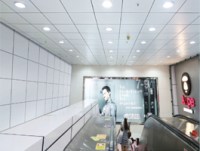
Tile Ceiling System
Ceiling tiles, also known as ceiling panels, are lightweight building materials used to cover ceilings. These ceiling tiles are backed with acoustic fleece, which not only offers heat insulation but is also intended to improve the space’s acoustics. The metal ceilings are installed on a grid, which is simple to install, easy to maintain, and improves the appearance of the ceiling.
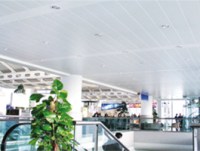
Linear Ceiling System
This concept comprises of linear metal ceilings made of aluminium that may be used indoors and outdoors and give visual continuity. This ceiling system has elegant modern lines that may be fitted simply with open reveals between panels or filled with filler strips for a more robust look. These ceiling panels come in both wood-look and plain colours. The holes between these panels can be left open for acoustic or air circulation purposes. Closed panels can also be ordered with either separate or integrated filler strips.
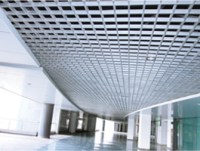
Open Cell Ceiling System
Open Cell Ceiling systems are utilised to produce a large impression, which is perfect for interiors would like open light or more height. Using this approach, it is simple to make various and distinct modules in one’s ceiling. Furthermore, the use of this technique is excellent for projects requiring a limited profusion depth. Typically, these ceilings are appropriate for projects that demand a lightweight and open style of ceiling. Corporate, transportation (airports, metro, bus, and railway terminals), retail, leisure, public space, and hospitality venues are instances of typical uses.
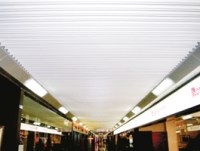
Screen Ceiling System
For the simple ceiling, Screen ceilings are made in three dimensions. The primary feature of this type of ceiling is that everything is composed of vertically hanging “suspended” panels. These beautiful suspended panels provide different visual patterns and lines without interfering with the sense of space. The appearance is either open or closed depending on the viewing angle of the ceiling. Our screen ceiling solution is ideal for customers who want to maintain the visible height of the offered area while providing the appearance of a false ceiling.
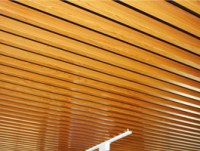
Baffle Ceiling System
Baffle Ceilings provide a semantic pattern with an open linear ceiling. Baffle ceilings are useful for creating ambiance within a space. These open ceiling structures provide a view of the profusion area and the concrete ceiling above. These ceilings are appropriate for remedial installation on concrete ceilings when a distinctive design or aesthetic upgrade to the area is desired.
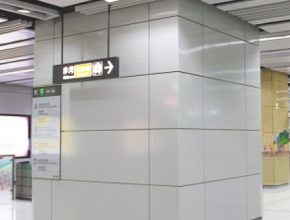
Aluminium Cladding
Aluminium Cladding is an excellent choice for building a long-lasting exterior. These claddings offer substantial benefits over other metals. Aluminium has a high degree of flexibility as it is one of the easiest metals to melt and bend. The metal is relatively easy to shape due to its low melting point. Furthermore, rust has less of an impact on aluminium due to its protective oxide covering, which allows it to last longer. Aluminium is a recyclable metal that can be remelted and reshaped without losing quality, making it more ecologically friendly.
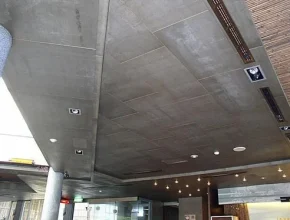
Cement Board Ceiling
Cement Board are 100% free from Asbestos. Envicrete Cement Board is specially designed for use in applications where impact resistance is required in a high humid environment. It is a versatile, economic building board substitute of plywood, cement-bonded particle board, gypsum boards or magnesium boards. It is light weight, robust and moisture resistant. Product Application: Internal Ceiling, External Ceiling partition walls, general external walls/ wet areas, raised floors and elevated floors.
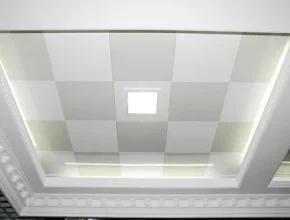
Gypsum Ceiling 8/4
Gypsum Ceiling is undoubtedly one of the most sorted choices in the market right now. The way you design your house can speak volumes about your nature, create a soothing aesthetic and awestruck people at your possessions. It is possible to get all of it done even when you are on a budget. The only thing to keep in mind is that you should have sound knowledge about the specifics of Gypsum Ceiling Design, what kind of styles will benefit the layout of your house, and what it is that you really want. Once you figure that out, narrow down on interior design experts who can work toward making your dream home come to life.
False Ceiling 2/42
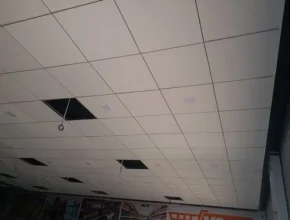
False ceilings are frequently secondary ceilings that are suspended below the primaryceiling using wires or struts. A variety of materials, including plaster of Paris (POP), gypsum board, asbestos sheets, particle board, aluminium panels, wood, etc., are used to make these ceilings. They are also referred to as suspended or dropped ceilings. Their primary purpose is toadd aesthetic value and charm to the interiors of a place. False ceiling contractors are well-equipped and trained professionals who know andpractise the art.You can find some of the best false ceiling contractors in your area by simply searching onthe internet and typing false ceiling contractors in Muddanur, Kadapa.
Installing Metal Ceiling
Understanding the requirements
This process involves substantial planning and discussion with the customer. At Tranquil, we value uniqueness and creativity, thus this is the most important step in which we seek to absorb the demands and instructions offered by the clients.
Product specification
This is the most vital step since we specify the product to the client or supply the material depending on their design, size, and colours. Based on the demands of the consumer, the applications of the materials are brought to life and made available.
Quantification
The quantification procedure informs the client about the quantity of materials required for the designated space. Concepts like as flexibility, feasibility, and adaptation will be explained to the customer. Size, form, colour, and acoustics, among other things, will be clarified and enhanced. Furthermore, all of these properties may be customised to the demands of the client.
Shop Drawings
This is the most visually appealing stage since the client will be able to grasp the full concept through a 2D depiction. This process clarifies, corrects, and aligns the project with the needs of the clients. These 2D drawings are presented for the manufacturing team, architects, contractors, and installation team to use as a reference.
Production
In this phase, the products are made based on the specifications provided by the client. Following manufacture, the products are subjected to a series of quality inspections before being ready for shipping and installation.
Installation
We not only manufacture products to your specifications, but we also install them through Tranquil Service Partners. Tranquil is the market’s all-arounder since we function as a manufacturer, supplier, and qualification in the installation process.
HOME POP CEILING
During house construction finishing works, contracts for false ceilings are usually turnkey, i-e labor & material both are to be provided by concerned contractor. This is more convenient and recommended method as POP material purchase can turn out to be a tough job
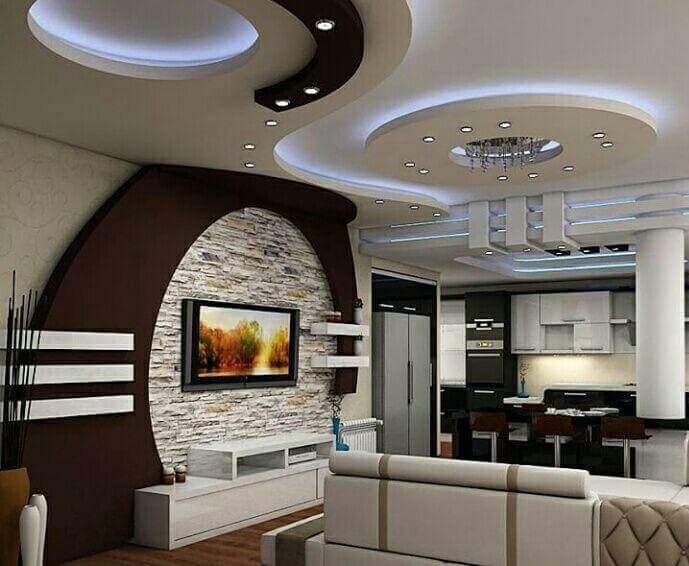
In modern houses, aesthetic and appealing look cannot be achieved in plain and simple ceilings. To give a customised look to ceilings, a technique is used which in local market is referred to as false ceilings. It is made using POP (Plaster of Paris) plates that are also called POP tiles.
POP tiles are made from powder that is obtained by crushing gypsum stone. Gypsum powder is mixed with water content ratio of .5 i-e 50% water and mixed until it turns into a form of paste. The paste is then poured into specially made mouldings of desired design along with a mesh of polythene threads that is used to hold the mixture together. Mixture is trowelled until it gets a smooth surface. Paste hardens within 15 to 20 minutes and is removed from moulding and placed in sunshine for drying. Drying period depends upon the season, in winters it usually takes 3 days to dry whereas in summers it dries in a day. A day or two old tiles are best to use because it start loosing its strength, as it gets old. In another method, these tiles are also made using coconut husk fiber instead of polythene threads to hold the mixture together, however such tiles are expensive due to the higher cost of coconut husk fiber and can only be made on pre-orders.
Quality check at site
- Tiles are freshly dried and not more than maximum 10 days old. As mentioned earlier that the POP tiles loose their strength with time if not utilised.
- Check the hardness of tiles with nails, it should be hard enough to only get a scratch on its surface. Soft tiles indicate low-grade material and there is a possibility that less gypsum powder and more water content ratio is used during mixing. This is a typical method used by some manufactures to get more tiles using less gypsum powder.
- Depth of tile should be at least 16 mm, or in local language 5 sootar. And the depth should be uniform throughout the tile, i-e from all corners and the centre
- Hardware used for fixing POP tiles should be of best quality. Wires used to suspend POP tiles from ceilings should be of pure copper in gauge 21. Steel wires are used by some contractors to save costs if they are working on turnkey contracts. Steel wires get rusty with time and become too weak to bear the load of POP tiles
- Copper hooks should be used to suspend steel wires from ceilings instead of steel screws.
- Hessian and coconut husk fiber should be used with POP mixture on rough side to cover the joints of POP tile,